Jump to main content

Talks

  1. De la fonction du processus de synthèse


    Nous analysons la fonction de la synthèse en partant de la production des connaissances en examinant ses opérations ainsi que ses dysfonctionnements contemporains. La montée d’un empirisme computationnel — fondé sur les protocoles standardisés, la production de données et la pression à publier — marginalise le travail théorique et empêche l’émergence de nouveaux cadres conceptuels. À partir du cas de la biologie, nous montrons que l’activité synthétique ne subsiste principalement que dans les articles de revue, nécessairement conservateurs, ce qui conduit à l’accumulation de contradictions et à la prolifération de métaphores et de concepts zombies. Nous identifions ensuite les conditions matérielles et organisationnelles de la synthèse, en mobilisant l’analogie des systèmes vasculaire et nerveux pour décrire l’intégration des processus locaux en unités globales cohérentes. Enfin, nous caractérisons la synthèse comme un processus anti-entropique, producteur de singularités fonctionnelles et garant d’une unité épistémique ; son érosion favorise le morcellement intellectuel et l’incohérence institutionnelle.

  2. Le défi épistémologique de l’intégration entre la systématique et le reste de la biologie


    La systématique donne, de fait, le système de référence de la biologie permettant de désigner ses objets, mais cet état de fait manque d'une intégration conceptuelle, épistémologique et méthodologique. Des domaines comme la génétique des population, l'écologie théorique, la biologie moléculaire ou la biologie des systèmes, en effet, s'appuient sur les relations causales synchroniques chez les être vivants. Ceci est particulièrement clair lorsque l'on considère leurs modèles mathématiques, largement hérités de la physique pour ce qui est de leurs structures et de leurs épistémologies. Surmonter cet obstacle épistémologique suppose de repenser le cadre théorique de la biologie comme un cadre épistémologiquement hybride, entre cadre historique et cadre relationnelle et synchronique, et de développer une écriture théorique et des méthodes adaptées.

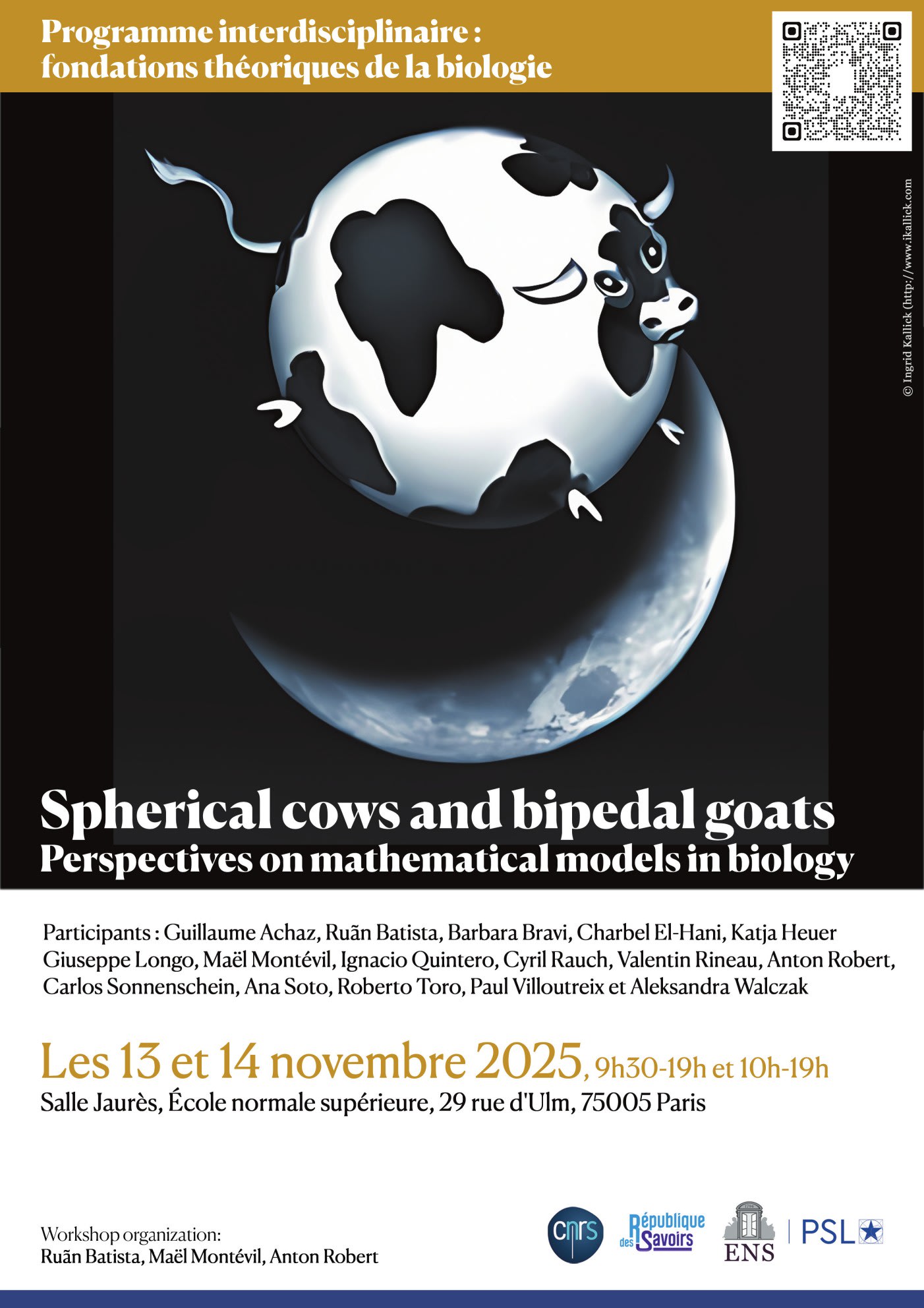
  3. Spherical cows and bipedal goats: Perspectives on mathematical models in biology

    • R Batista
      R Batista
      ,
      M Montévil
      M Montévil
      &
      A Robert
      A Robert
      .
    • en
    • Amphi Jaurès, 29 rue d'Ulm, École Normale Supérieure

    This event aims to take a step back and reflect on everyday mathematical modeling. We aim to organize a discussion on the diversity of this practice in biology and the homologies in current models. We wish to center those discussions around two related problems. First, given that the general reference system of biology builds on a notion of novelty to classify living beings, how can we use mathematical structures (using predefined spaces of possibilities) to describe living beings while avoiding contradiction? Is it reasonable that many of these practices do not even consider the organization of the organisms? Second, if models can be considered as instruments that contribute to shaping scientific reasoning, is their inscription within broader theoretical frameworks (not) necessary? Are data-based approaches sufficient to understand the living, or should theoretical and methodological jumps be performed? Is the perspective of the National Research Council sound when it states that not all New Biologists are now, or will in the future be, biologists? How to take mathematics and modelling seriously and, at the same time, avoid the disruption of biological knowledge by the fetishization of those tools?

  4. Disruptions in biology: Theorizing a hallmark of the anthropocene


    Biologists often use the term "disruption" informally to describe the effects of detrimental anthropogenic causes. A proper concept of disruption should be distinct from perturbations or, in ecology, from generic disturbances. We illustrate this with examples from ecology, using the case of plant-pollinator networks, from organismal biology, with endocrine disruptors, and at the interface of psychological and cognitive development with digital media and young children. Specifically, we argue that understanding disruptions requires the articulation of historical and relational reasoning. The object of disruption, such as endocrine regulation or seasonal synchrony between plants and pollinators, is a specific property coming from history that is disturbed in a new, random way, leading to a loss or degradation of this specificity. Moreover, initially, this specificity plays a specific relational role, typically a functional one. This role is lost or impaired by the disruption, which explains the disorganization characteristic of disruptions. In our view, however, disruptions are a normal part of the evolutionary process. What is severely detrimental in the Anthropocene is the accumulation of disruptions at a pace that exceeds the ability of living entities to overcome them.

  5. Theory and theorization in the sciences


    To a large extent, the question of theoretical frameworks in the sciences has been neglected (or poorly treated) in philosophy. In parallel, we argue that scientists themselves are currently neglecting this question, and we will show the consequences of this situation in biology. We will then provide elements of the definition of scientific theories, which are partly grounded in the activity of theorization itself. We will articulate this discussion with the question of the function of theories and theorization in the sciences.

  6. Séminaire sur le vivant 2025-2026

    • M Montévil
      M Montévil
      ,
      C Petit
      C Petit
      &
      A Robert
      A Robert
      .
    • fr
    • École Normale Supérieure

    Perpétuant les orientations impulsées par Jean-Jacques Kupiec lors de sa création, le séminaire Cavaillès se donne pour objet l'histoire et la philosophie des sciences du vivant. Une fois par mois un acteur des sciences expérimentales ou humaines est invité à y présenter ses travaux et réflexions. Le séminaire se veut ouvert à toutes et à tous, avec l'objectif de croiser les regards, partager les connaissances et favoriser les échanges sur un large spectre de thématiques et de questions. Il entend être le témoin de la vitalité, l'actualité et la fertilité des recherches en épistémologie historique des sciences biomédicales, ainsi que de leur incidence sur les débats scientifiques contemporains.

  7. Disruptions: A specific kind of disorganization


    Biologists often use the term disruption more or less informally; however, this notion is increasingly used to describe the effects of detrimental anthropogenic causes. We argue that disruptions are distinct from perturbations or, in ecology, from generic disturbances. We illustrate this with examples from ecology using the case of plant-pollinator networks and organismal biology with endocrine disruptors. Specifically, we argue that understanding disruptions requires the articulation of historical and relational reasoning. The object of disruption, such as endocrine regulation or seasonal synchrony between plants and pollinators, is a specific property coming from history that is disturbed in a new way, leading to a loss or degradation of this specificity. Moreover, initially, this specificity plays a specific relational role, typically a functional one. This role is lost or impaired by the disruption which explains the disorganization characteristic of disruptions. In our view, however, disruptions are normal processes in evolution. What is severely detrimental is the current accumulation of disruptions at a pace that exceeds living entities' ability to overcome them.

  8. Concepts and principles for the new biology: Development, disruption and normalization


    During the first 25 years of the 21st century, we witnessed a resurgence of Organicism. This process is characterized by the return of the organism as a central biological entity and the increasing investigation on purpose and normativity at this level.
    Simultaneously, the issue of the vulnerabilities of living beings and their numerous disruptions is escalating in urgency. The need to comprehend these disruptions, and how living beings adapt to them, is pressing. Organicism, with its systemic approach to disruptions and its focus on organisms’ normativity, is the most suitable framework for this understanding.
    In this session, we will:
    1) explore the epistemological role played by the morphogenetic field concept in the studies on the etiology of tumors in the early 20th century and its resurgence in the organicist conception of cancer as development gone awry (presented by Claudia Gadaleta, Paris 1 Sorbonne Panthéon - IHPST, Paris, France),
    2) argue that a properly fleshed-out concept of disruption describes the effects of a significant category of detrimental anthropogenic causes in organisms and ecosystems. Understanding disruptions requires articulating historical and relational reasoning, which is a hallmark of recent theoretical developments (presented by Maël Montévil, Centre Cavaillès, Ecole Normale Supérieure, Paris, France)
    3) argue that disruption causes a loss of function. The organismal agency may overcome disruption by acquiring novel functions, a process we call normalization. We will discuss two examples: i) how young quadrupeds that lost the function of their forelimbs teach themselves to walk as bipeds, and ii) cancer, a disease usually perceived as irreversible but known to regress spontaneously by normalization (presented by Ana Soto, Tufts University, USA and Centre Cavaillès, Ecole Normale Supérieure, Paris, France).


  9. Extension du domaine de soin


    Ce séminaire a pour vocation de constituer un espace de réflexion et de discussion autour des textes de l’œuvre publiée et des archives non publiées disponibles au fonds CAPHÉS. Creusant le sillon de la journée d’étude sur les inédits de Canguilhem, ces rencontres permettront une analyse détaillée et approfondie de l’ensemble de l’œuvre canguilhémienne, au-delà de la seule thèse princeps (Le Normal et le pathologique). Il s’agit à la fois de faire connaître et approfondir de manière graduelle l’œuvre canguilhémienne, tout en nouant des liens avec ses autres écrits et les pensées avec lesquelles il entre en dialogue ou lorsque ce n’est pas le cas recueillir les échos, que ses idées rencontrent chez d’autres penseurs et chez d’autres disciplines.

  10. Quelques défis théoriques et épistémologiques entre biologie et conception orientée milieu


    La biologie théorique contemporaine prend en charge et renouvelle certaines questions fondamentales : notamment la question de l’historicité et la question des niveaux d’organisation – ainsi que le sens accordé à ce dernier terme. Nous présenterons certaines avancées dans ce domaine qui recoupent les questionnements et les défis rencontrés dans la conception orientée milieu.

  11. Qu’apelle-t-on produire ?


    Les notions de production et d’industrie ont, contre leurs origines historiques, été confinées dans les deux derniers siècles à ce que l’on appelle le secteur secondaire, le secteur primaire étant, lui, dévolu à la matière dite première et qui regroupe pelle-mêle l’exploitation du vivant sauvage et domestique ainsi que l’extraction minière. Pourtant les fourmis sont bien – plus ou moins – industrieuses, le concept de reproduction est l’un des plus fondamental en biologie et même les processus physiques irréversibles produisent de l’entropie. Le passage à l'échelle de ces différents types de production est néanmoins distinct - et cette question est centrale pour l'industrie. Alors que le champs et les acteurs de l’industrie se reconfigurent tant pour des raisons technologiques « qu’écologiques », il nous semble pertinent de repenser ce que signifie produire à l’aune tant de la physique que de la biologie et de la technologie.

  12. Physiology and historicity: Re-entangling the biological, the ecological and the social

    • M Montévil
      .
    • en
    • Colloque “philosophy of health – rethinking organism, environment and metabolism”
    • Sorbonne Université Salle des Fresques, Escalier D Salle D306, Paris

    Depending on the theoretical and epistemological stance in biology, the relations between the biological and social change in nature. A reductionist stance, for example, genocentrism, focuses scientific investigations on a specific part of the organism - then, the social stands, at best and by definition, in the outskirts as far as biology is concerned. On the opposite, the perspective we are elaborating for reasons internal to biology considers biology at the crossroads of historical and relational epistemologies. The object's definition is never purely based on synchronic relations, like in physics. Instead, biological objects are historical and contextual. Cultural or social determinations can enter the biological picture, more or less strongly depending on specific situations. For example, taste is a phenomenon that involves specific biological structures (taste buds, olfactory receptors), and one may think that it is independent of society. Food pairing studies showed instead that the way to perform associations depends on the culture. Of course, historicity also means that other receptors can also creatively be recruited, which is the case with the capsaicin of chili pepper that triggers pain receptors.

  13. The closure of constraints in practices

    • M Montévil
      M Montévil
      &
      A Robert
      A Robert
      .
    • en
    • Salle de réunion du centre Cavaillès, ENS

    What understanding does the closure of constraints bring about a biological system in practices? Without discussing particular cases, one cannot answer this question. The goal of this workshop is to bring together and synthesize individual modeling experiences in physiology and ecology to establish perspectives of research collectively regarding organization in biology, sensu closure of constraints.
    This workshop is intended to a specialized audience. We encourage speakers to present models or modeling methods, and share critical reflections on their work and the difficulties encountered. Identifying achievements, open questions, perspectives, and experimental, conceptual or technical difficulties is the main goal of this meeting.
    Additionally to relatively short Q&A sessions, a general discussion will synthesize the main points raised during the day. This synthesis will be transcribed and shared with the participants after the workshop.

Filter by year to see more talks.