Jump to main content

Contents tagged “individuation”

There are 2 contents with the tag “individuation”:

  1. Individuation et désindividuation

    Atlas des sciences de la culture


    La notion d'individuation renvoie à deux idées liées mais distinctes. Les individus forment des unités à peu près insécables, comme le terme l’indique et les individus sont distincts les uns des autres.

    Abstract

    La notion d’individu a une grande importance en sciences sociales, notamment à travers la doctrine de l’individualisme méthodologique qui se propose de comprendre les phénomènes sociaux sur la seule base des individus et de leurs interactions, un point de vue atomiste donc. Cette notion renvoie à deux idées liées mais distinctes. Tout d’abord, les individus forment des unités à peu près insécables, comme le terme l’indique. De plus, les individus sont distincts les uns des autres, ainsi que séparables, au moins analytiquement, de leurs contextes. L’individuation renvoie alors à deux questions. Tout d’abord, sur quelles bases identifier les différents individus et les distinguer de leurs contextes ? L’individuation est alors la question théorique et épistémologique de l’identification des différents individus. Deuxièmement, notamment à la suite de Simondon, la notion d’individuation peut être une manière de dépasser l’atomisme inhérent au concept d’individu, en posant l’individuation comme première par rapport aux individus. Alors, l’individuation est le processus qui devient le centre de l’intérêt théorique.
    Citation
    Montévil, Maël. n.d. “Individuation et Désindividuation.” In Atlas Des Sciences de La Culture, edited by Lia Kurts-Wöste, Jean Lassègue, Régis Missire, Vincent Michaud-Laine, and Muriel van Vliet. Classiques Garnier
    Manuscript Citation Full text
  2. Toward a theory of organisms: Three founding principles in search of a useful integration

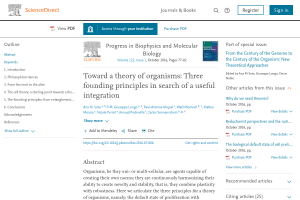
    Toward a theory of organisms: Three founding principles in search of a useful integration

    Progress in Biophysics and Molecular Biology


    We articulate three principles for a theory of organisms proposed, namely: the default state the principle of variation and the principle of organization.

    Abstract

    Abstract Organisms, be they uni- or multi-cellular, are agents capable of creating their own norms; they are continuously harmonizing their ability to create novelty and stability, that is, they combine plasticity with robustness. Here we articulate the three principles for a theory of organisms, namely: the default state of proliferation with variation and motility, the principle of variation and the principle of organization. These principles profoundly change both biological observables and their determination with respect to the theoretical framework of physical theories. This radical change opens up the possibility of anchoring mathematical modeling in biologically proper principles.

    Keywords: Default state, Biological organization, Organizational closure, Variation, Individuation

    Citation
    Soto, Ana M., G. Longo, P.-A. Miquel, M. Montevil, Matteo Mossio, N. Perret, A. Pocheville, and Carlos Sonnenschein. 2016. “Toward a Theory of Organisms: Three Founding Principles in Search of a Useful Integration.” Progress in Biophysics and Molecular Biology 122 (1): 77–82. https://doi.org/10.1016/j.pbiomolbio.2016.07.006
    Manuscript Citation Publisher Full text

See all tags.