What do mainstream scientists acknowledge as original scientific contributions, that is, what is the current épistémè in natural sciences?
Abstract
What do mainstream scientists acknowledge as original scientific contributions? In other words, what is the current épistémè in natural sciences? This essay attempts to characterize this épistémè as computational empiricism. Scientific works are primarily empirical, generating data and computational, to analyze them and reproduce them with models. This épistémè values primarily the investigation of specific phenomena and thus leads to the fragmentation of sciences. It also promotes attention-catching results showing limits of earlier theories. However, it consumes these theories since it does not renew them, leading more and more fields to be in a state of theory disruption.
To provide a rational assessment of COVID-19 vaccines, we take a step back on both the history of this practice and the current theories in immunology.
Abstract
Vaccines for COVID-19 have led to questions, debates, and polemics on both their safety and the political and geopolitical dimension of their use. We propose to take a step back on both the history of this practice and how current theories in immunology understand it. Both can contribute to providing a rational assessment of COVID-19 vaccines. This assessment cannot consider vaccine as an isolated procedure, and we discuss its intergradation with the broader question of knowledge and politics in the COVID-19 pandemic.
How do mathematical models convey meaning? What is required to build a model? An introduction for biologists and philosophers.
Abstract
Mathematical modeling is a very powerful tool for understanding natural phenomena. Such a tool carries its own assumptions and should always be used critically. In this chapter, we highlight the key ingredients and steps of modeling and focus on their biological interpretation. In particular, we discuss the role of theoretical principles in writing models. We also highlight the meaning and interpretation of equations. The main aim of this chapter is to facilitate the interaction between biologists and mathematical modelers. We focus on the case of cell proliferation and motility in the context of multicellular organisms.
Keywords: Equations, Mathematical modeling, Parameters, Proliferation, Theory
Can big data replace theoretical thinking? How should these technics be used? A critical discussion on the use of big data in biology.
Abstract
Some authors assert that the analysis of huge databases could replace the scientific method. On the contrary, we argue that the best way to make these new technologies bear fruits is to frame them with theories concerning the phenomena of interest. Such theories hint to the observable that should be taken into account and the mathematical structures that may link them. In biology, we argue that the community urgently needs an overarching theory of organisms that would provide a precise framework to understand lifecycles. Among other benefits, such a theory should make explicit what we can and cannot predict in principle.
Keywords: Big Data, biological variation, cancer biology, knowledge, theory
Citation
Montévil, Maël, and G. Longo. 2018. “Big Data and Biological Knowledge.” In Predictability and the Unpredictable. Life, Evolution and Behaviour, edited by Giulia Frezza and David Ceccarelli, 133–44. Roma: CNR Edizioni
Que peuvent apporter les approches Big Data en biologie? Peuvent-elle être traitée de manière agnostique. Peuvent-elle remplacer la réflexion théorique?
Abstract
Certains auteurs affirment que l’analyse des grandes bases de données pourrait remplacer la méthode scientifique. A contrario, nous argumentons que la bonne manière de faire fructifier ces nouveautés techniques est de les encadrer théoriquement. En biologie, en particulier, il nous semble urgent de développer une théorie des organismes.
Biological variation should be given the status of a fundamental theoretical principle in biology. Variation goes with randomness, historicity and contextuality.
Abstract
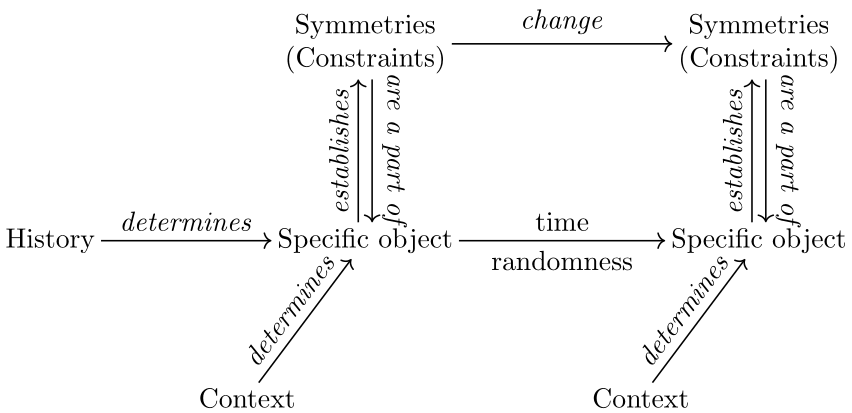
Abstract Darwin introduced the concept that random variation generates new living forms. In this paper, we elaborate on Darwin’s notion of random variation to propose that biological variation should be given the status of a fundamental theoretical principle in biology. We state that biological objects such as organisms are specific objects. Specific objects are special in that they are qualitatively different from each other. They can undergo unpredictable qualitative changes, some of which are not defined before they happen. We express the principle of variation in terms of symmetry changes, where symmetries underlie the theoretical determination of the object. We contrast the biological situation with the physical situation, where objects are generic (that is, different objects can be assumed to be identical) and evolve in well-defined state spaces. We derive several implications of the principle of variation, in particular, biological objects show randomness, historicity and contextuality. We elaborate on the articulation between this principle and the two other principles proposed in this special issue: the principle of default state and the principle of organization.
Keywords: Variability, Historicity, Genericity, Biological randomness, Organization, Theory of organisms
We articulate three principles for a theory of organisms proposed, namely: the default state the principle of variation and the principle of organization.
Abstract
Abstract Organisms, be they uni- or multi-cellular, are agents capable of creating their own norms; they are continuously harmonizing their ability to create novelty and stability, that is, they combine plasticity with robustness. Here we articulate the three principles for a theory of organisms, namely: the default state of proliferation with variation and motility, the principle of variation and the principle of organization. These principles profoundly change both biological observables and their determination with respect to the theoretical framework of physical theories. This radical change opens up the possibility of anchoring mathematical modeling in biologically proper principles.
We propose a biological default state of proliferation with variation and motility by analogy with physics inertia. Then, quiescence requires an explanation.
Abstract
Abstract The principle of inertia is central to the modern scientific revolution. By postulating this principle Galileo at once identified a pertinent physical observable (momentum) and a conservation law (momentum conservation). He then could scientifically analyze what modifies inertial movement: gravitation and friction. Inertia, the default state in mechanics, represented a major theoretical commitment: there is no need to explain uniform rectilinear motion, rather, there is a need to explain departures from it. By analogy, we propose a biological default state of proliferation with variation and motility. From this theoretical commitment, what requires explanation is proliferative quiescence, lack of variation, lack of movement. That proliferation is the default state is axiomatic for biologists studying unicellular organisms. Moreover, it is implied in Darwin’s “descent with modification”. Although a “default state” is a theoretical construct and a limit case that does not need to be instantiated, conditions that closely resemble unrestrained cell proliferation are readily obtained experimentally. We will illustrate theoretical and experimental consequences of applying and of ignoring this principle.